Skip to content
  • Home
  • About
  • Blog
  • Freebies
  • ShopExpand
    • Shop Website – CAD
    • Shop TPT – USD
Search
A Pinch of Kinder Logo

Reading

Writing

Math

Seasonal

Inquiry

Classroom

A Pinch of Kinder Logo
Home / Shop / Single Product / Digital Math for Kindergarten | Equal Share Activities | Google Slides™
  • Digital Math for Kindergarten Equal Share Cover
  • Digital Math for Kindergarten Equal Share Thumbnail 1
  • Digital Math for Kindergarten Equal Share Thumbnail 2
  • Digital Math for Kindergarten Equal Share Thumbnail 3
  • Digital Math for Kindergarten Equal Share Cover
  • Digital Math for Kindergarten Equal Share Thumbnail 1
  • Digital Math for Kindergarten Equal Share Thumbnail 2
  • Digital Math for Kindergarten Equal Share Thumbnail 3
PDF Preview

Digital Math for Kindergarten | Equal Share Activities | Google Slides™

Number of Pages: 41

File Type(s):

  • Google Apps

$4.00

Buy on TPT
Add To Wishlist
Remove From Wishlist

Save with a Bundle!

This product can also be found in:

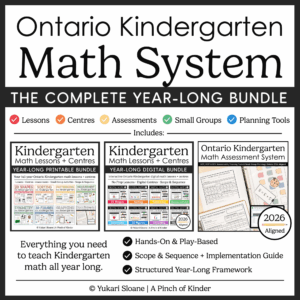
  • Sale! Ontario Kindergarten Math System Cover

    Ontario Kindergarten Math System | Year-Long Curriculum | Printable + Digital

    $478.00 Original price was: $478.00.$260.00Current price is: $260.00.
    Add to cartLoading Done
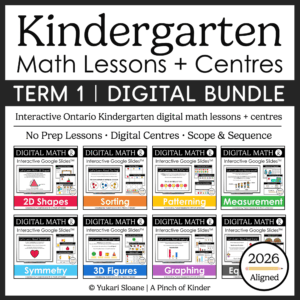
  • Sale! Ontario Kindergarten Digital Math Bundle | Term 1 Google Slides™ Lessons Cover

    Ontario Kindergarten Digital Math Bundle | Term 1 Google Slides™ Lessons

    $66.00 Original price was: $66.00.$52.00Current price is: $52.00.
    Add to cartLoading Done
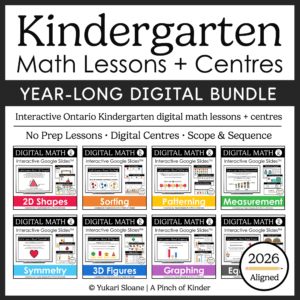
  • Sale! Kindergarten Math Lessons and Centres Year Long Digital Bundle Cover

    Year-Long Digital Kindergarten Math | Google Slides™ Math Bundle

    $185.00 Original price was: $185.00.$109.00Current price is: $109.00.
    Add to cartLoading Done
  • Description
  • Reviews (0)

Digital Math for Kindergarten | Equal Share Activities | Google Slides™ | Ontario 2026 Aligned

Looking for interactive kindergarten equal sharing activities you can use for digital math centers, whole-group lessons, or distance learning?

This Google Slides™ equal sharing resource gives your students hands-on drag-and-drop practice solving equal-share problems using concrete materials and visual models.

Students learn how to share items fairly, build an understanding of what “equal” means, and explore what happens when items cannot be shared equally (leftovers).


Perfect for:

✔ Whole-group teaching on the SMARTBoard or projector
✔ Digital math centers
✔ Google Classroom assignments
✔ Distance learning
✔ Hybrid classrooms


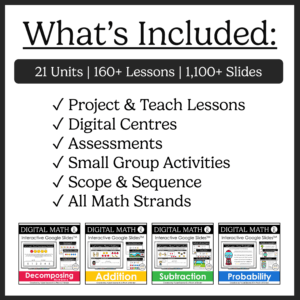
What’s Included:


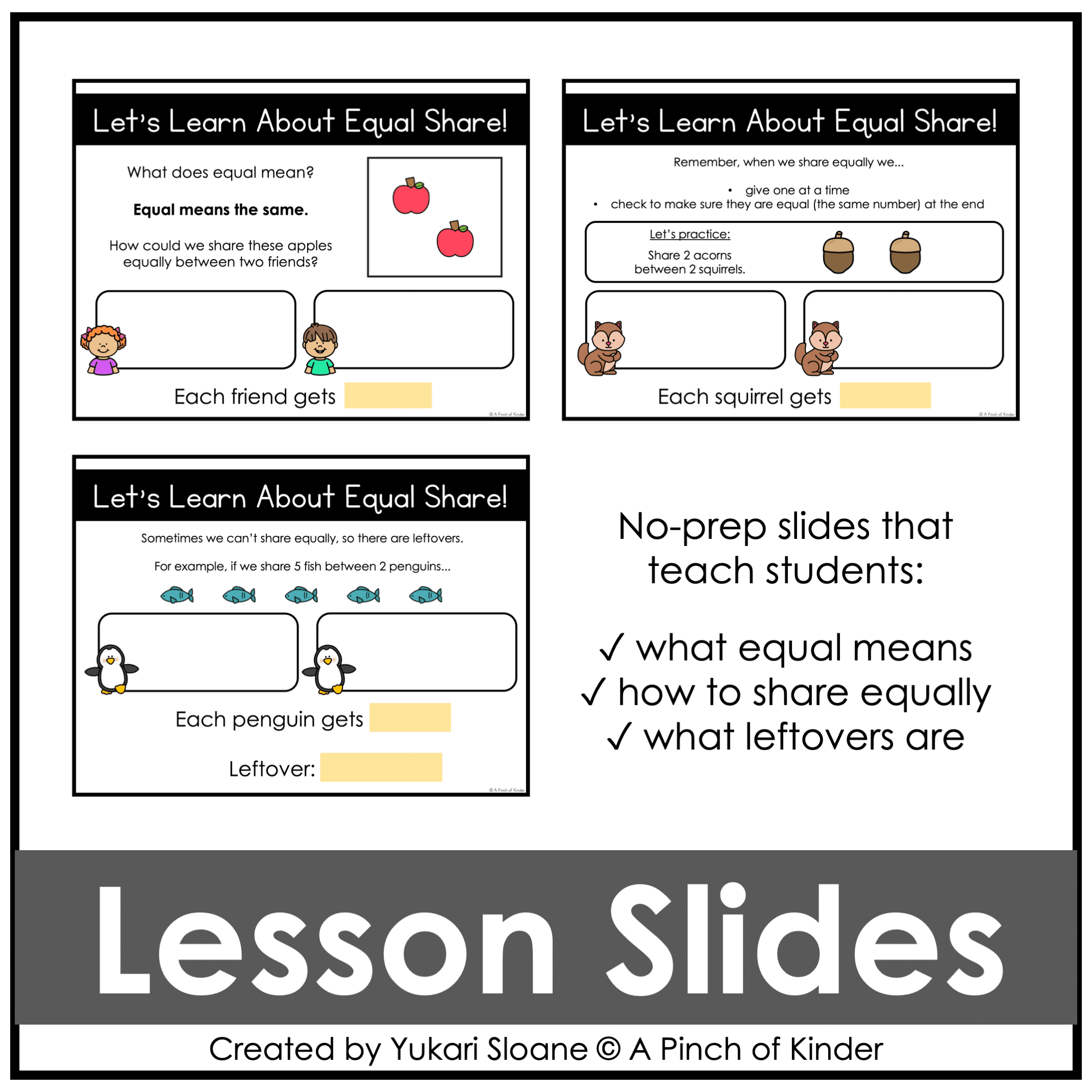
⭐ Lesson Slides (Slides 1, 12)

Introduce and teach:

  • What equal means
  • How to share items fairly
  • How to give one at a time
  • How to check if groups are equal

👆 Use these slides for direct instruction before independent practice.


⭐ Guided Practice Slides (Slides 2–3)

Students:

  • Practice sharing items between 2 and 3 groups
  • Follow step-by-step equal sharing
  • Build understanding through repeated structure

These slides reinforce the process of sharing one at a time.


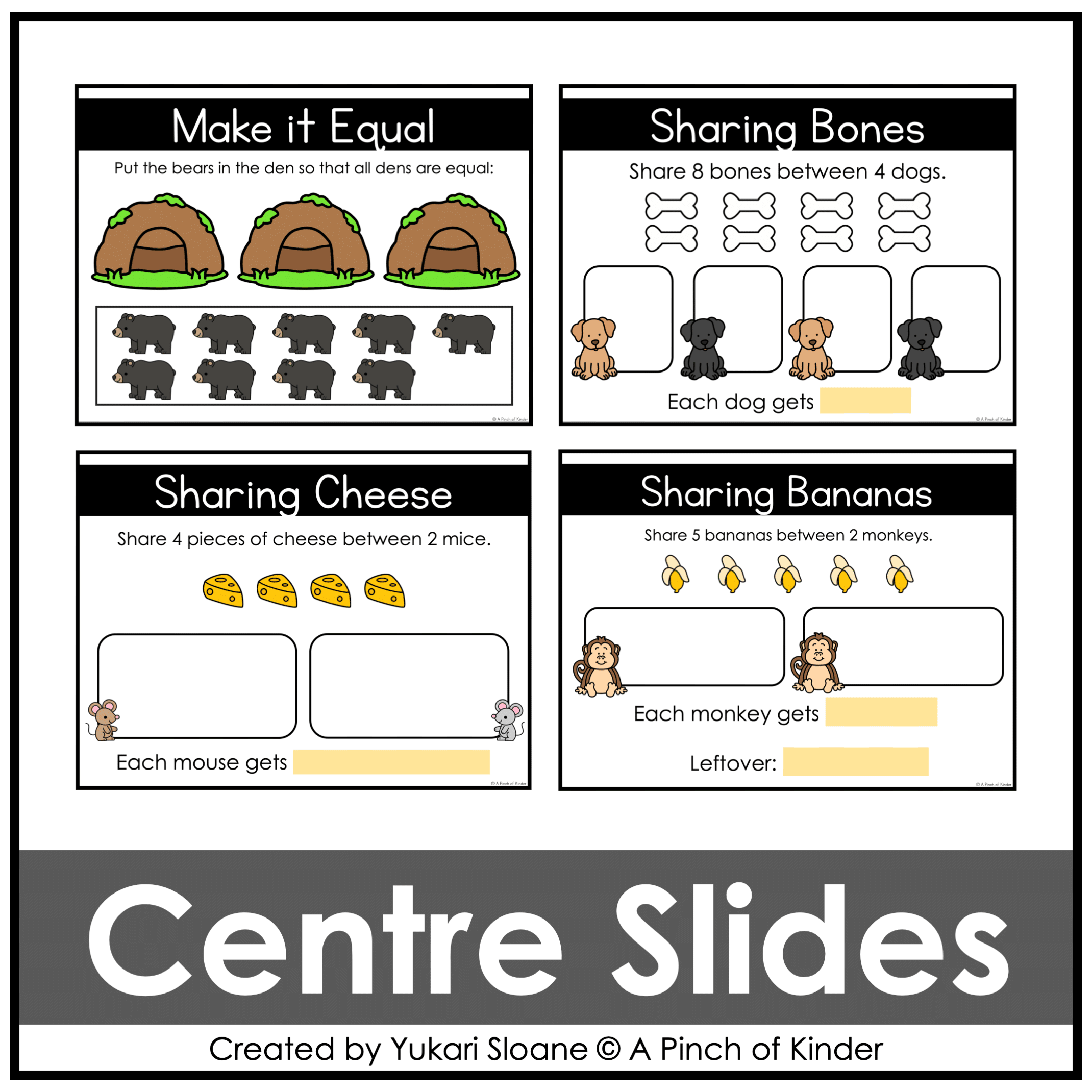
⭐ Make It Equal (Slides 4–11)

Students:

  • Drag and drop bears to make groups equal
  • Check their work visually
  • Adjust groups to ensure fairness

Includes 2, 3, and 4 den options.


⭐ Equal Sharing Practice (Slides 13–31)

Students:

  • Solve equal sharing problems
  • Drag and drop items to share between groups
  • Click and drag the yellow boxes to reveal and check their answers

Scenarios include sharing between 2, 3, and 4 groups.


⭐ Leftover Concept Slide (Slide 32)

Students:

  • Explore what happens when items cannot be shared equally
  • Identify and count leftovers
  • Complete simple equal-share sentences

This introduces early division thinking in a developmentally appropriate way.


⭐ Leftover Practice (Slides 33–41)

Students:

  • Solve equal sharing problems with leftovers
  • Share as fairly as possible
  • Identify how many are leftover

This builds deeper understanding of equal vs. not equal situations.


Skills Students Develop:

  • Understanding equal as “the same amount”
  • Sharing fairly using one-to-one distribution
  • Recognizing equal vs. not equal groups
  • Solving simple equal-share problems
  • Identifying and counting leftovers
  • Explaining their thinking using math language


This digital unit builds the foundation for:

→ Early division concepts
→ Problem solving and reasoning


Why Teachers Love This Resource:

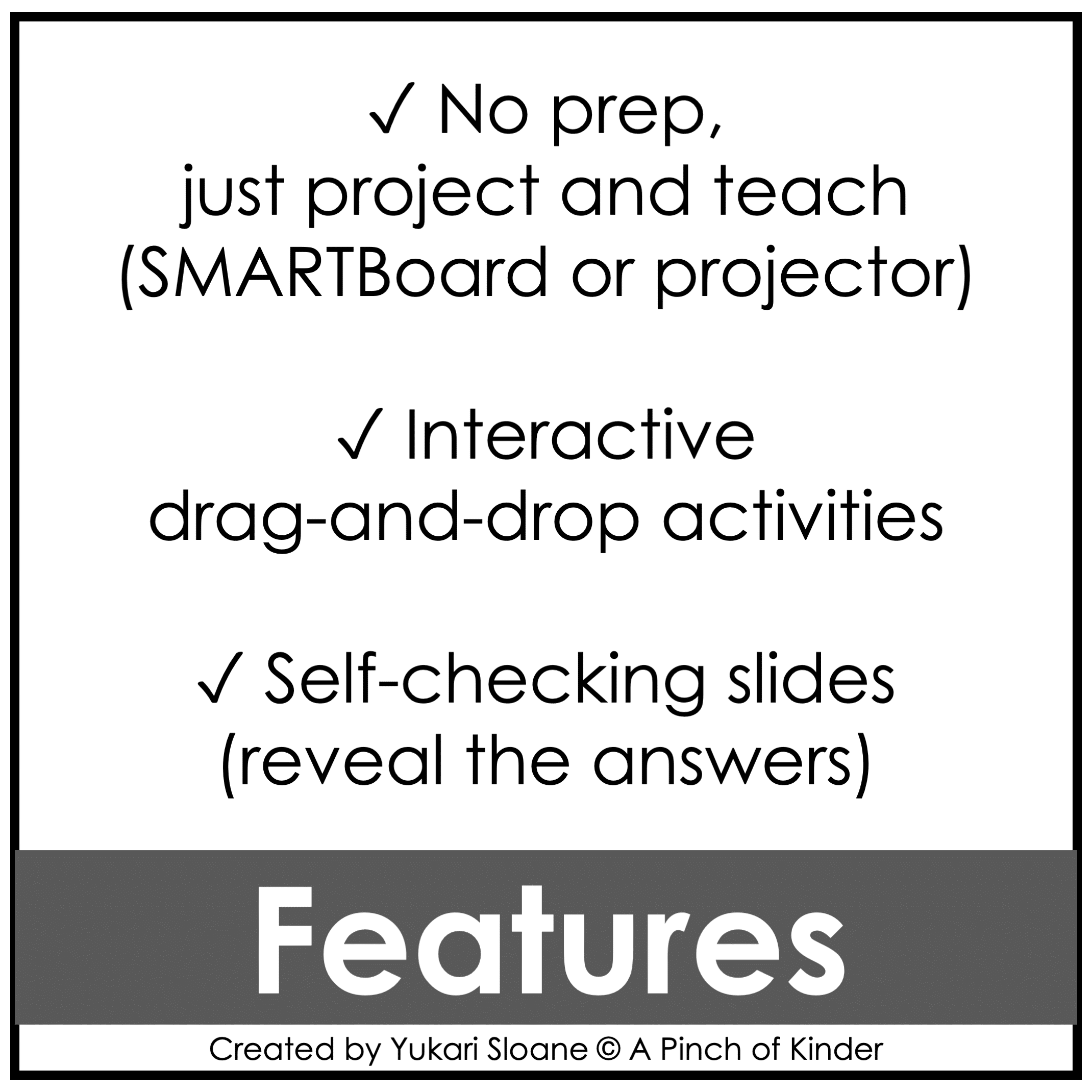
✔ No prep — just assign or project
✔ Engaging drag-and-drop format
✔ Builds real understanding of equal sharing
✔ Introduces leftovers in a simple, visual way
✔ Encourages mathematical thinking and discussion
✔ Works for in-person OR digital classrooms
✔ Ontario-aligned


Curriculum Alignment (Ontario 2026):

This resource has been created for the new equal share expectation:

A6.9 solve equal-share problems using concrete materials

from the 2026 Ontario Kindergarten Math Curriculum.


Tech Tips:

  • Use in EDIT mode (not Present mode) so movable pieces work.
  • If assigning in Google Classroom, students using iPads/tablets must have the Google Slides app installed to manipulate pieces.
  • You may also download the slides as a PowerPoint file to use on a SMARTBoard.


Try Before You Buy!

Not sure if this format works for you?

Grab my FREE Digital Math for Kindergarten | Tally Marks | Google Slides™ to try it for free first.


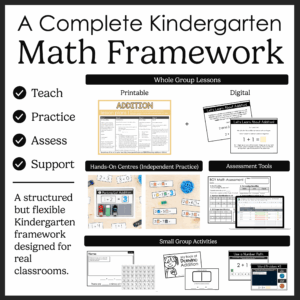
If you love this resource, be sure to check out my other Digital Math for Kindergarten activities or my complete year-long digital math program💛

Reviews

There are no reviews yet.

Only logged in customers who have purchased this product may write a review.

Related products

  • Digital Math for Kindergarten Tally Marks Cover Digital Math for Kindergarten Tally Marks Thumbnail 1

    Digital Math for Kindergarten | Tally Marks | Google Slides™

    $0.00
    Add to cartLoading Done
  • Digital Number 15 Activities Cover

    Kindergarten Number 15 Activities | Digital Math for Google Slides™

    $1.25
    Add to cartLoading Done
  • Digital Math for Kindergarten Skip Counting Cover Digital Math for Kindergarten Skip Counting Thumbnail 1

    Digital Math for Kindergarten | Skip Counting | Enrichment & Extention

    $7.00
    Add to cartLoading Done
  • Digital Math for Kindergarten Number Lines Cover

    Digital Math for Kindergarten | Number Path & Line Activities | Google Slides™

    $5.50
    Add to cartLoading Done
Instagram
Facebook
Pinterest

Hi, I’m Yukari!

I love sharing lessons and activities that have worked well in my Kindergarten classroom to provide you with engaging ideas and to help you cut down your planning time!

Check out my story below to learn more about the why behind A Pinch of Kinder.

my story contact me
✨ 3 FREE Resources for the Beginning of Kindergart ✨ 3 FREE Resources for the Beginning of Kindergarten! ✨

Getting ready for the first few weeks of Kindergarten? I’ve rounded up three FREE resources to help with both planning and early literacy:

🔤 Alphabet Sensory Bin Activity
✏️ Alphabet Charts
📝 Editable Day Plan Template

Swipe through for a closer look at each one 👉

Want all three? Comment START and I’ll DM you the links! 💬

Not ready to plan yet? Save this post so you can come back to it when you are 👇

#kindergartenfreebies #kindergartenliteracy #firstweekofkindergarten #kindergartenplanning #kindergartenteacher
✨ Kindergarten Classroom Setup Ideas ✨ Setting up ✨ Kindergarten Classroom Setup Ideas ✨

Setting up your Kindergarten classroom for the first time—or just looking to switch things up this year?

Swipe through for a peek inside one of my Kindergarten classrooms, including room organization, storage and play-based centres that worked right from the first week!

I’ve also shared several detailed “Classroom Reveal” blog posts filled with even more photos and ideas.

Want to browse them for inspiration? Comment SETUP and I’ll DM you the links! 💬

Not ready to think about classroom setup yet? Save this post for when you are 🤍

#kindergartenclassroom #classroomsetup #kindergartencentres #playbasedlearning
Back-to-school prep can feel like one giant, never Back-to-school prep can feel like one giant, never-ending to-do list 🫠

But you don’t need to prepare everything at once.

When I taught Kindergarten, I divided my prep into a few stages:

☕ Before we received our class list
☕ Once we knew our students’ names
☕ During the first week
☕ And a few things I purposely waited to create

This helped me focus on what was actually needed next—rather than trying to prepare the entire school year before the first day.

I put my complete Kindergarten start-up checklist, more details about how I prepared and several FREE editable templates into one blog post for you!

Comment STARTUP and I’ll send it directly to your inbox 💌

And if you’d like your first-week slides, family forms and classroom tools prepared for you too, you can find them together in my Kindergarten Back-to-School Bundle. It’s linked inside the post!

Save this carousel for when you’re ready to start preparing—and send it to a Kindergarten educator who might need a more manageable place to begin 🤍
Centre time can mean very different things in diff Centre time can mean very different things in different classrooms.

Some teachers use assigned groups and must-do rotations. In my Kindergarten classroom, centre time looked different.

Students chose from intentionally planned activities and play spaces around the classroom. Literacy and math invitations were always available, but students weren’t required to complete a specific number of them.

That doesn’t mean the learning was left to chance.

The literacy and math invitations built on our whole-group lessons and gave students opportunities to revisit familiar skills independently. More targeted instruction happened through flexible individual and small-group work based on what students needed next.

But centre time was about more than academic practice.

It was also where students learned to:

✨ Make choices
✨ Advocate for themselves
✨ Join play
✨ Share materials and space
✨ Solve small problems
✨ Develop independence
✨ Build a sense of belonging

These aren’t simply routines students need to master before the “real” learning begins. They are important Kindergarten skills too.

And what about the student who never wants to leave the block centre?

As long as they are playing independently, working well with others, using the materials appropriately and staying at an appropriate volume…I’m generally okay with it.

I finally put all of my most frequently asked centre questions into one detailed blog post, including how I introduce and organize centres, protect small-group time and document learning. I’ve also included the free Google Doc we used for documentation and my FREE Visual Centre Plans.

Comment CENTRES and I’ll send you the post! 🫶

Please note: This is what worked well in our two-educator Ontario Kindergarten classroom, as well as the year I was U15 and the only educator. However, every class, educator team and school context is different — and there is more than one effective way to structure centre time.
One of the first things I work on during Kindergar One of the first things I work on during Kindergarten literacy is names.

Not because every child needs to be printing their name perfectly in September, but because name learning supports so many important early literacy and classroom skills.

Recognizing their own name helps children become more independent. They can begin to find their cubby, locate their belongings, identify their work and participate in classroom routines with less adult support.

Not only does this build their confidence—it makes things a little easier for you, too. 😉

Names also make letter learning meaningful. Instead of beginning with a completely unfamiliar set of letters, children can explore the letters in a word that is already familiar and important to them.

And name activities are incredibly easy to differentiate.

One child may be learning to recognize their name from a few choices. Another may be matching or ordering the letters. Others may be ready to spell it, trace it, print it independently, recognize classmates’ names or begin working on their last name.

I like to introduce some of these activities as whole-group literacy centres first. We practise how to use the materials and complete each activity together before students are expected to work independently.

Then, for children who need additional repetition, I use the same familiar activities to create individual name bags.

Because the activities have already been introduced, the bags are easy to use during:

✏️ teacher-led small groups
✏️ targeted literacy support
✏️ time with a classroom volunteer
✏️ practice with a supply teacher
✏️ and eventually, additional practice at home

The adult does not need to teach a brand-new activity, and the child can focus on the name skill instead of trying to figure out unfamiliar directions.

And the best part?

All of these editable name activities—plus several more not shown—are FREE!

Comment NAME and I’ll send you the direct download link along with the full blog post. ✏️
Why teach 2D shapes before sorting? Why teach deco Why teach 2D shapes before sorting? Why teach decomposing before composing? And why leave concepts such as money and probability until later in the year?

When I first started teaching Kindergarten, I knew which math concepts I needed to cover — but I wasn’t always sure what should come first or how the skills should build on one another.

Over time, I refined my scope and sequence based on classroom experience, student readiness, assessment data, developmental appropriateness and the Ontario Kindergarten curriculum.

The result is a sequence that moves from concrete, accessible concepts toward ideas that require more number sense, independence, language and abstract thinking.

Of course, it is still a flexible roadmap. Concepts overlap and spiral throughout the year through centres, play, daily routines and small-group instruction.

I shared more of the reasoning behind each part of my Kindergarten math scope and sequence in a new blog post.

Comment SCOPE and I’ll send you the link. 🤍

Save this post for your summer planning!
The first week of Kindergarten is busy enough alre The first week of Kindergarten is busy enough already, so let me help you make math easy!

I created this First Week of Kindergarten Math Freebie to help you start the year with simple, hands-on math that feels manageable.

Inside, you’ll get:

✔ Google Slides lessons for Numbers 1–3
✔ Number Roads Centre
✔ Number Match-It Centre

The lessons are great for whole-group teaching, and the centres give students simple, hands-on practice with number recognition, number formation, counting, and early number sense.

It’s meant to give you a starting point without having to plan everything from scratch.

Comment MATH and I’ll send it your way🤍
Logging off for a few days. ☀️ I purposely didn’t Logging off for a few days. ☀️

I purposely didn’t bring my laptop so I could be as present as possible with my family. 🤍

I’ll share all the highlights when I’m back! Can you tell where I am?

See you Tuesday!

P.S. If you noticed the sneak peek… no, you didn’t. 🤫

links

  • Home
  • About
  • Blog
  • Contact
  • Freebies
  • Privacy Policy
  • Terms and Conditions

topics

  • Reading
  • Writing
  • Math
  • Seasonal
  • Inquiry
  • Classroom

shop

  • Shop All
  • Shop Bestsellers
  • Shop Bundles
  • My Account
  • FAQ
  • Refund Policy

search

social

Instagram
Facebook
Pinterest

©2024 A Pinch of Kinder. All Rights Reserved. Site Design by Ashley Hughes

Shop in CAD

Shop the site

Shop in USD$

shop TPT

Lost your password?


Don't have an account yet? Sign up

Review Cart

No products in the cart.

A Pinch of Kinder Logo
Cookie Consent
To provide the best experiences, we use technologies like cookies to store and/or access device information. Consenting to these technologies will allow us to process data such as browsing behavior or unique IDs on this site. Not consenting or withdrawing consent, may adversely affect certain features and functions.
Functional Always active
The technical storage or access is strictly necessary for the legitimate purpose of enabling the use of a specific service explicitly requested by the subscriber or user, or for the sole purpose of carrying out the transmission of a communication over an electronic communications network.
Preferences
The technical storage or access is necessary for the legitimate purpose of storing preferences that are not requested by the subscriber or user.
Statistics
The technical storage or access that is used exclusively for statistical purposes. The technical storage or access that is used exclusively for anonymous statistical purposes. Without a subpoena, voluntary compliance on the part of your Internet Service Provider, or additional records from a third party, information stored or retrieved for this purpose alone cannot usually be used to identify you.
Marketing
The technical storage or access is required to create user profiles to send advertising, or to track the user on a website or across several websites for similar marketing purposes.
  • Manage options
  • Manage services
  • Manage {vendor_count} vendors
  • Read more about these purposes
View preferences
  • {title}
  • {title}
  • {title}
Scroll to top
  • Home
  • About
  • Blog
  • Contact
  • Shop
    • Shop Website – CAD
    • Shop TPT – USD
  • Freebies
Search
Instagram Facebook Pinterest

Reading

Writing

Math

Seasonal

Inquiry

Classroom